Welcome

This web log contains the website content for our journeys on Reflections IV from April 2000 to December 2008.
Click there to start at the start.
Col, Liz, Courtney & Anna

Friday, August 01, 2003

August 2003 The Gulf of Thailand


Photo SlideShow


Pengkalang Kubor, Malaysia
The most valuable piece of information we gained from Jim off Remington was a mud-map of the border town Pengkalang Kubor and river entrance. This appeared on our chart as just coastline but in reality this is a proper breakwater formed harbour, well set up with leads and lights.

Our second trip from Perhentian Island was hindered by motor problems - this was the first time in the four years we've had the boat that the motor has just stopped. The fuel level was low and the fuel lift pump was not up to the task. Temporary adjustments got us under way OK.

We came into Penkalang Kubor and had our first views of Thai longtails. These boats have long shafts with exposed propellers that are lifted in and out of the water to stop the boats. We anchored in "no-mans water" with Malaysia to the south and Thailand to the north. Going ashore was a matter of landing at the immigration checkpoint and explaining we were on a boat in the river and they let us through.
 

First thing was to get some fuel. Inquiries at the harbour-master's office and a trip in the dinghy and a small shipyard with a bowser on a jetty was found upstream in a small inlet. We crept in the shallow waters and just got alongside the fishing boats. We got our fuel and enjoyed checking out the fishing boats which are built incredibly strong with two-inch thick timbers. We usually have popcorn for morning tea so we made extra for the fishing boat crews, who responded by giving us a few packets of noodles. When the fuel man was finished he gave us a large bottle of drinking water as a parting gift. So nice to do business in such circumstances.

Back in the river ashore a duty-free shopping centre was found. The big drawcard was alcohol, which is 50% cheaper. Liz and the girls had a day in Kota Baru to visit the Museum of Royal Customs and a quick look at the markets which was cut short by two sensitive noses disagreeing with the smells. They reported it was worth it just for the bus trip in as they saw several beautiful Wats - Buddhist temples. A taste of what was to come in Thailand.
 

We went over to the Thailand side for a wander and although this was fun and we had a nice Roti (flat bread) dinner in the markets, the complexity of clearing Immigration for an hour visit was a bit much. We caused a bit of confusion back at the Malaysian side as we now wanted to have our passports stamped to reenter. They wanted to just let us in and couldn't understand why this time we needed entry stamps in our passports.

Saiburi, Thailand
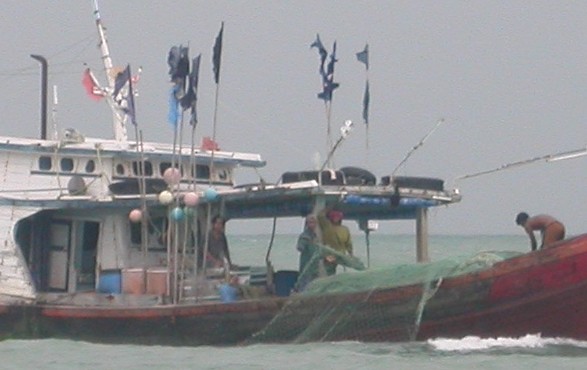
 The next day we headed out north. The weather was fine and we had a pleasant sail up the coast. We came into a small inlet at the town of Saiburi. This was, like Pengkalan Kubor a well defined breakwater. The Lonely Planet book noted that this area was well known for the decorative paintwork on the fishing boats. We had front row seats to study their work as they passed us on their way out to fish for the night. Our 'royal wave' was well tested as the procession passed us waving cheerfully.
 

Not long after sunrise we were woken by the engines of the fishing boats returning. With the tide slack we were laying sideways across the waterway so we thought it best to get going. Another good sail and we were now 80 miles north of the Malaysian border when we reached Pattani. We had no information on anchorage or the harbour entrance, but as we arrived we noticed a large commercial vessel leave, so the channel should be deep enough for us.

But not the way we went! We touched the sand and muddy bottom and got stuck. Getting off by spinning the boat at 90 degrees to the wind and hoisting our sails to lay the boat over worked well. Following the port hand side of the channel, we made our way in. The river was moderately wide but was chock-a-block with fishing boats, so much that we couldn't find anywhere to anchor. Making our way back out we found a spot behind a sand spit and anchored for the night.

Songkhla
  Pushing on to Songkhla was just another day on the move, highlighted by catching the largest spanish mackerel yet. We came into this major port with no problems. The harbour was very busy with car ferries, fishing boats and large ships all buzzing about. Every few hundred metres there was a row of fishing stakes protruding out into the harbour. These are arranged so that to go up the harbour a constant zigzag has to be performed. We were thrilled to see the large Buddhist temples and shrines around the city as we went along.


Wandering round our first Thai city was great fun. New sights and smells everywhere. Songkhla harbour continues on to open into a large inland lake system which is vast, covering thousands of square kilometres. We went to the island of Ko Ro which is just outside of Songkhla and connected to the shore by long bridges. There is a folk museum there, which concentrates on art and culture of southern Thailand. The museum is set on a hill which gives wonderful views of the surrounding inland sea. Starting at the top the museum leads you through a series of rooms showing off most aspects of Thai history and cultural practices of today. Also stunning views of the villages and inland sea are everywhere through the large windows in many rooms. Very good.

As with most Thai cities (we assume) Songhkla has many fine wats and temples and worth a wander around. We found a large market with lots of 'finger-food' and, while we weren't always sure what it was, some delicious tastes were found. The variety of seafood was incredible with large tiger prawns and unusual fresh water fish.As with most photos in this web site, hold your mouse steady over the photo to see the caption describing the photo.

While at anchor in the harbour the sound of firecrackers going off were heard all the time. At first we thought it was a celebration of the queen of Thailand's birthday but later we noticed the fishing boats were the culprits, letting off a string of crackers off the bow as they left. As we left Songkhla a large boat in front of us stopped repeatedly to let some off. From Songkhla an overnight trip brought us to Koh Samui.


Ko Samui
The area where Ko Samui lays has several islands around it: Samui, Phangan to the north, Tao to the north west and the An Thong islands to the west. I (Colin) came here in 1988 and the increased development since my last visit has made the place almost unrecognisable.

We first anchored at Bo Phut on the north eastern corner of Samui and it seemed the wind intensified as we came in to anchor. This was a good anchorage and although the wind was blasting over the deck the water was calm. There are (as with every peice of sand on Koh Samui) resorts/restaurants lining the beach and we found this was a quiet place with many families about. European languages seemed to dominate the air. We made our way to NaThon, the ferry terminal town, by sawngthaew - small utilities with bench seats in the back. Here we checked in with Immigration and Customs and collected the girl's schoolwork.


We stayed at Bo Phut for a few days and on the radio heard two yachts we knew (Kaiviti & Valor) who were in Chaweng which is the main tourist strip. We went around to see them and the busier part of town to find a very rolly and windy anchorage. The beach landing in the surf provided too much of a challenge with Col ending up face first in the wet sand! Chaweng is one long strip of shops offering souvenirs, CD & DVDs, clothes, shoes, Thai massages, travel agents, Internet, motorcycle hire, and food. Normally all in the same store! And a McDonalds of course.

It seemed terribly similar to the streets of Kuta, Bali. Bo Phut was a much nicer place in all regards - pace of life and quality of anchorage.

Ko Phangan
After a night of being tossed around in our bunks we moved north to Koh Phangan the large island north of Koh Samui. We went into Haad Rin, on the south east corner. We found Jim on the yacht Remington here and it was good to catch up with him. I (Colin) stayed here in 1988 and the change was incredible. Then there were around 500 rooms on the island. Now there are 5000!

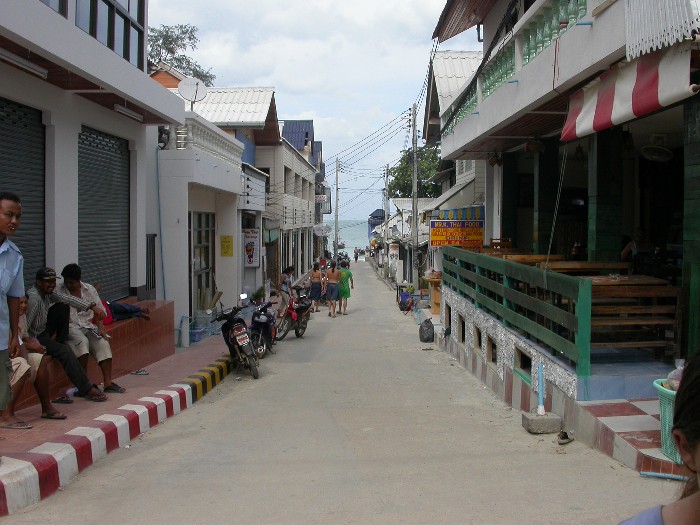
The have a huge party each full moon on this beach with thousands of people partying and sleeping on the beach. All the stores have large displays of booze for sale, so it must be quite a night.

From there we had a lunch stop at Thaansadet, a small beach with lovely waterfalls. Several of the kings of Thailand have had holidays here with inscriptions on the stones a big draw card for local tourists.


From Thaansadet a short trip of a few miles brought us to Haad Thong Naay Paan. This is a very protected bay and a good night's sleep was enjoyed by all. The bay has lots of resorts ashore and the beach has fine sand and we stayed here a few days to catch up on a few jobs and schoolwork. We ate ashore a lot and enjoyed sitting in the beachside restaurants in the cool of the evenings. English was seldom heard as the customers seemed to be mainly European. Luckily the girls found a pair of English children on the beach and this made trips ashore all the more fun for them them and the boys to have someone to play with.


We moved on to the next bay only a few miles further north before moving on twenty miles north to Koh Tao. This island is well know for diving with the water much clearer than Samui or Phangan. This was very obvious when we arrived at Mae Haad, the only town on the island. For the first time in ages we were able to drop the anchor in 8 metres of water and watch it hit the bottom and the chain lead away as we dug it in.

Koh Tao
Mae Haad is a small town with possibly the highest concentration of dive shops on the planet. It seemed every second shop was a dive shop. The explosion in development is fairly recent and is clearly focused for the majority European tourists, with quite a few classy looking cafes on the street with some fine looking pastries in the window. Interesting how lots of tourism tends to remove the culture they came to see and replace it with their own.

After doing some shopping we moved over to Koh Naang Yuan, a small group of three islands just off the Koh Tao coast. These three islands are joined at low tide by small sandy beaches. A resort occupies all three islands and the whole place is incredibly scenic. We decided to let Courtney do a dive course here. At the tender age of 11 she is old enough and, we feel, sensible enough to go diving. She was over the moon about this and worked hard at the course. She proved very confident and capable with her instructor being very impressed. Liz went on the last two dives with her and commented that she was a pleasure to dive with.


The dive course package included accommodation so we had the luxury of a unit in the forest overlooking Koh Tao as a land base for three days.

Liz and I also went for a dive Chumporn pinnacles, large rocks that tower up from the bottom (35 metres) to 20 metres below the surface. This was marked as the best dive in the area and although it was very enjoyable it was not so fantastice. We arrrived at the site with about ten other dive boats there and we guess that there were 30 other divers in the water with us.


Most of the photos on the web are taken by Colin but these two gems were set up and shot by Anna with the self-timer.


Photo SlideShow


Sunday, June 15, 2003

June 2003 Up the east coast of Malaysia - continued


Photo SlideShow


Tioman Island
After three weeks we finally reached our first milestone of an east coast cruise - Tioman Island. This is a large island with several kampongs (villages) and several anchoring options. Many people come here for holidays and there is a variety of accommodating here. We needed a few supplies and hopefully beer at a reasonable price.

We sailed across from Sembilang/Sribuat islands and anchored in Tekek bay. We mucked about anchoring as it was deep (14metres) and shoaled to reef very quickly. Once satisfied we went ashore and were please to find small supermarket which had what we needed and not much difference in price compared to the large supermarkets in JB. Tioman is a duty-free island for beer and cigarettes. We picked up a case of Carlsberg cans for RM50 (A$22) which was much better than RM106 in JB.

That night we had clouds build up over the island which looked ominous. Later that evening after some rain the wind picked up and shifted suddenly. Feeling the boat slew Liz and I got up to check all was OK. Don's full keel ketch Valor was laying abeam (side-on) to the wind in front of us. Liz shouted that he was dragging and by the time I'd walked to the bow it was clear he was going to clean us up. I shouted out to raise him and he popped up from the other side of the boat, having just returned in his dinghy from dinner on Katrine.

As the boats came to touch Liz and I jammed fenders between and Don got his motor going. The boat slowly crabbed over the top of us and I held my breath as the stern went over our anchor chain. Don's boarding ladder jammed into the chain and smashed itself to bits. He then got clear of us and headed out to deep water to winch his anchor up. On the radio he then reported his dinghy was missing. We searched by spotlight that night and then along the shore in the morning but with no luck.

In the morning we only found the timber barge board along the gunnel of our boat chipped and no other damage. Valor sustained no damage except for the loss of the ladder and dinghy. In a way he was lucky to have come onto us as the reef was a only a short distance behind us.

The southerly wind blew up each afternoon and made the anchorage a bit uncomfortable so we moved a short distance north to anchor in Teluk Salang (Teluk is the Malay word for bay). This was not a lot better and crowded with fishing boats so we continued on right around the island to Juara Bay on the eastern side. We tucked in the southern corner and found it a bit rolly from the swell. We planned to stop a while so we went to the trouble of setting an anchor off the stern to hold the boat pointing out to sea with it's bow into the swell. This worked really well and we had a very comfortable two weeks here.


There are many small cabin style resorts with basic amenities up to air-conditioned units. These are relatively small and have a low visual impact making the bay look very picturesque. The Kampung (village) of Juara is well catered for with electricity, water, an excellent jetty with water and a concrete path running the length of the bay, which is effectively the main street..


In the corner of the beach there was a fresh water stream which was accessible in the dinghy at high tide. A few hundred metres upstream there was a small hydroelectric power station. The outfall of the power station became a daily destination as it was a great place to do laundry and have wash. The trip was very pretty with a large banyan tree overhanging and lots of wildlife. We saw many monitors and smaller lizards, macaques and kingfishers.

We saw some interesting groups come to stay. The resort closest to us had over a hundred Muslim clerics (we assume that's what they were) come for a three day stay. At each of the five prayer sessions they would gather in a room and chat and dance for about an hour. Quite an effort for three days. After they left we heard on the VHF radio an Australian accent calling "Warship Norman". Soon we saw several Naval vessels come in the bay and then they started coming ashore and unpacking gear. We learned that the Australian, NZ, Malay, British & Singaporean Navies we all together for annual exercises. Juara was the site for the dive/mine hunting teams. So for the next ten days they set up flags around the bay and did their stuff.

One night Liz noticed lots of their inflatable boats buzzing around. After retiring, she heard a motor close by and when she got up to investigate she saw a red light in the water underneath the boat. The divers surfaced and held on to our dinghy and said "It's OK we're just doing exercises". They were Australian as it turned out. The next day while ashore a senior officer came up and apologised. While there was no harm done and with so many of them in the bay it was clear who they were, the situation would have been quite different if we had just arrived and were unaware of the exercises. Being robbed at night by someone boarding the boat is a real concern for cruising yachts and many carry weapons.


Tulai Island and on to Kuantan
Over the next few days the military things started to wind down and we started to think about moving on. Liz and the girls walked over the island and I sailed the boat round to Tekek to meet them. While they enjoyed their walk and the motor bike ride up the path on the eastern side, they weren't so impressed about the torrential rain they. Meanwhile, on the boat I had a quiet relaxing trip around in sunshine.

Katrine was there and another yacht named Namir. Namir is from Keri Keri, NZ and has Bob, Joanie, Lisa (11) and Ryan (16) aboard. They were making their way south after going up to Koh Samui. Lisa and the girls got on well and we had her for a sleep-over and she sailed with us to Tulai island just five miles away. Tulai has excellent coral reefs and is as good as we've seen anywhere in Malaysia. We also enjoyed snorkeling in the mangroves at high tide, watching the mangrove jack swim in and out of the tree roots. Quite a different experience.

The next day Namir left and we had another day at Tulai but always with an eye on the sky as the anchorage is not great. Sure enough the next morning we had gray skies and the squalls started to come in. After an hour or two of squalls we decided to 'bug out'. Destination unknown. The girls asked Liz and I where we were going to go to and we truthfully admitted we didn't know. We ran north with over 20 knots of southerly behind us with just the headsail. If the wind stayed up we'd just run with it and continue north. Not long before dark the wind eased and the main went up. The boat was trimming along smoothly now and we decided to reach across to Kuantan on the mainland.

We anchored at 3:00am in an open bay just north of the Kuantan river and had rolly sleep. Next morning, with a rising tide we went into the river. Our 'mud map' - a sketch passed down from yacht to yacht, told us to go the wrong way around a port marker. We also had been told the the larger 'C' class fishing boats (they have a big C painted on the side, draw enough water to stay in the main channel so we followed them in. Luckily we saw that the channel had changed and we followed them several hundred metres to port of the marker. Liz updated the sketch accordingly.

We spent several days at Kuantan and enjoyed the calmness of being anchored in a river. To get ashore we had a long trip in the dinghy up to a public ferry jetty. This put as at the bus station and pretty well in the middle of the city. The main mosque is the big landmark and the soft blue/gray colours make a stunning sight. After checking out the shopping malls and wandering the streets, and collecting some supplies of food we moved on further up the coast.


Chukai
A 35 mile trip along the coast brought us to Chukai, once again on a river. This entrance was simpler as there were leading marks which proved to be correct. The main settlement is about a mile up the river. Surrounded by forest the river had many eagles soaring over it and we could see the branches swing with monkeys in the forest. We anchored just off a park and were only metres from the middle of the town. We stayed just the night and moved on.

The next day's sail was very pleasant. We had light southerly winds and sailed all day. The coast line seemed to be one long beach broken occasionally by a headland. At one point we passed a huge a refinery complex with burn off chimneys blazing and a large tanker on a mooring close to the shore. The chart showed a large oil/gas field offshore and many submarine pipelines feeding in. Much of Malaysia's wealth comes from oil revenue.

Kapas Island
60 miles up from Chukai was Kapas Island. Our dream sail with steady winds all day changed with the onset of an afternoon storm. The island wasn't too far so we dropped our sails and motored the last few miles into the blackening sky. The storm had passed over as we arrived and, in the dark, we spotted some boats moored and picked a spot just out side of them. Next morning we moved up to the northern end of the island and found beautiful bay formed by Kapas island and a smaller island nearby. This bay was deserted and girls enjoyed taking the dinghy ashore to play on the beach.

This is a very popular island for the residents of Kuala Terrenganu. We found camping grounds here and small resorts. This was the first place we've seen Malaysians camping. We watched a youth group of boys and girls erecting tents on the beach which reminded us al lot a school camp we went on with the girl's school in Brisbane.

Kuala Terengganu
Kuala Terengganu is the capital of Terengganu state and is set on a river - so we could go there! The entrance was straightforward and we anchored just inside river entrance. We found a really great market with a football field sized fruit/vege/fish market and upstairs narrow crowded crafts/clothes shops going everywhere. The Chinatown area was fun to explore and Liz found some pork meat and other Chinese supplies.

We went to the state museum which was very impressive. The buildings are large concrete structures built in the style of traditional buildings with large reliefs and ornate gables, all set around large beautifully kept gardens. Inside we saw displays on textiles, dress, music, jewelry and of course, a history of the local sultans. Sponsored by Petronas, the state oil company, there was a large building dedicated to how beneficial the oil industry is.

A visit to the ports officer confirmed that we didn't need to clear Malaysia here but at the border town of Pengkalan Kubur


Redang Island
From Kuala Terenganu we had a long sail/motor to Redang island. We'd set out early and arrived in the north east bay just before dark. The bay was very deep in shape and high hills provided good protection. Which was why there were so many fishing boats in the bay. They raft up together and then run a line back and another group raft up. We counted eleven rafted alongside each other.

That night a squall blew up and with thundering rain, the wind bulleted down really hard and from different directions. We held our ground OK and luckily the fishing boats did as well.

There are two beaches of fine white sand on the shore. One is the site of a large high class resort. Going ashore the girls eyed the swimming pools and the next day they played 'resort guests' for the day, lounging in and around the poolfront.


Perhentian Islands
We sailed across the twenty miles from Redang Island with the big event being we caught a fish! A lovely big spanish mackerel. We were technically inside the marine reserve area when we picked it up. Once we anchored a large police boat anchored nearby and they started fishing off the back. So much for the no-fishing rule.

The police boat was at least 30 metres long and one night we had a squall come up and the police boat dragged past us and only was metres from the reef when they rapidly reversed away. We suspect they were having trouble getting their anchor up.

We found the snorkeling excellent, with very clear water and lots of large plate coral formations and many more fish than we've seen elsewhere. There lots of restaurants and chalets ashore and most have a dive shop as well. A dive with gear costs 70 ringgit (A$30).

There are two islands here and we were are in a bay within the channel between the two islands. With beautiful white sand beaches and rocky outcrops on the points of the bay it is a very picturesque place.

At one of the dive shops Liz met a British family on a working holiday. They had a seven year old boy, Jack, who enjoyed playing with the kids. One day he turned up at the boat with his schoolwork. He was cagey when we asked if his Mum & Dad knew where he was but assured us everything was OK. Later that day his mum, Noeline, turned up and told us that he'd told the staff in the dive shop where he was going and hitched a ride on a boat out for the visit. Still, he got a fair bit of work done.


Kota Baru
We left Perhentian,sailed to the coast and anchored off the beach. The river was too shallow to enter so this was the only way to visit Kota Baru. We went ashore, found a bus into town and found what the girls described as Nirvana. A McDonalds with and Internet cafe inside it. Of course it was called McCyber's.

Kota Baru is considered the centre for Malay culture and also has a more strict Islamic regime. The cultural centre holds regular concerts and we enjoyed hearing the different instruments. The singing however was another thing and after a couple of songs we slipped out.

A storm had gone through while we were ashore, and on return to the beach the sound of the surf was ominous. We prepared for the launch... a quick jump in, row like mad while the motor is prepared for a start. It all went well until the top of a wave just got us and threw a bucket of water over the motor. Continue rowing like mad. We were away! But a second break was still to be crossed. Success but substantially wetter.

At the boat we found our home tossing around madly. Getting aboard was a matter of timing.... Wait for the gunnel to come down. Step on and zoom... up you go! That night was the worst night's sleep we've ever had. The boat tossed and rolled irregularly, with the waves and a swell rebounding off the beach. The dinghy got covered in anti-fouling painting as the boat rolled and the the dinghy wiped against the exposed bottom.

The next day was gray and threatening. We motored up towards the next harbour at Tumpat. As we approached it the wind intensified and the idea of risking entry into the harbour which was very shallow (three metres on the chart) was not appealing.

So, tired and exasperated, we turned round and ran downwind the thirty miles back to Perhentian. The strong winds (20-25 knots) were fine as tail winds and the sail back went well. This turned out fruitful as we anchored at Long Beach on the larger of the pair of Perhentian islands. This is a backpacker hangout and there we met Jim off the yacht Remington who had lots of information on the coast north to Koh Samui.

Time for a new web page that takes us to Thailand.


Wednesday, June 04, 2003

June 2003 Up the east coast of Malaysia


Photo SlideShow
We headed back down the Johor Strait from Johor Bahru and rounded Singapore island. There is a seriously large amount of shipping plying these waters and our boat seemed very small as we made our way along the edge of the shipping lanes. We had no dramas but it was an exhausting day keeping track of where each ship was going.


The Seribuat Archipelago 
After clearing Singapore we hoped to anchor for then night at some small islands just on the 'corner' of the Malay peninsular. As we approached we realised it was no good with far too much swell to have any hope of sleeping during the night. So we pushed on, somewhat reluctantly but with no other choice. An overnight run would get us to Palau (island in Malay) Sibu. We had 10-15 knots of wind and running downwind in the lumpy swell was no good so we reached out a long way and then reached back in. This is a good strategy to get a more comfortable ride and so what if it takes a bit longer.

Sibu Island
We anchored out wide just before dark and then after breakfast went to the northern tip and found a beautiful calm bay to anchor in. There is a small resort here (Rimbu Resort) and we found the people there very welcoming. The girls were so pleased to be able to go swimming again - all of us were really. Later on in the day two yachts came into the bay and anchored. Mike & Sylvia off the sloop 'Kai Viti', and Don off the ketch 'Valor'. They had spent the last four months in Sebana Cove Marina near Singapore and were planning to do the same trip as us. Mike & Sylvia used to be TAFE teachers (I worked for TAFE NSW for nine years). During our stay the girls found some kids staying at the resort to play with and we enjoyed the adult company of the resort guests and the other yachts.
 

There are tracks from the resort to the other beaches/resorts on the islands. We went for a walk and a swim to the eastern side and had a very pleasant walk through the bush and a swim in the small surf.

Tinggi Island
From here we moved across to the nearby island of Palau Tinggi. This translates to 'tall island' and is dominated by an extinct volcanic cone. We anchored in the southwest corner. Here there was a school and other official buildings. The main reason for the village's existence must be the school as it was the vacation period and the place was almost a ghost town. Still it was nice to wander round and have a look about. There were no cars and two concrete paths made up the street network. Pot plants were everywhere, which gave the place a distinct style.

The weather pattern we encountered was the usual steady southerly wind and a swell coming from the west. The trouble to find a good anchorage was to get out of the wind and the swell. At this anchorage we were open to the wind which was OK as the reef cut down the wave action, although as the tide changed we'd lay sideways to the wind/waves which was a bit unpleasant but tolerable.

The next anchorage was at the northern tip of Palau Tinggi with the hope of a calm bay like Sibu Island. We came into the bay and found a large rocky shoreline and, feeling a bit threatened by the 'hard edge' of the water', anchored out wide. The shoreline rose to meet to the volcanic peak of the island, giving a spectacular look to the anchorage, but.... While the wind was blowing we felt comfortable but that night in the calmer conditions we rolled around and no scenery could offset the lack of sleep from tossing about.


Tossing about when you're at sea is taken for granted - the price to travel this way, but tossing about when you're stopped is not on!

Babi Besar Island
We moved on to Palau Babi Besar Island. This had a lovely long sandy beach on the western side but the risk was we were open to the wind - but the beach looked very inviting. Going ashore we found several resorts along the now familial concrete path/street. The two up-market ones had signs stating they were closed to the public. The reason was they were booked out entirely by a Swedish film crew who were filming a 'Survivor' style series. The people hanging around the resort were quite unfriendly and had that "I'm at work therefore I am not enjoying this look" - even while in the pool with a beer in hand! There were several elaborate sets on the beach. The participants were 'stored' on another island and were brought in to complete their tasks.
 

Apart from the Swedes jogging around the island was very quiet with only noise being cows mooing as they roamed free. . We enjoyed a beer here and there and had a reasonable hamburger for dinner one night. We stayed three nights and although not the smoothest of anchorage the girls really loved the beach. A catamaran named "Katrine" came in and we all met Don and Jean while having a long chat aboard their very nice boat. They are South African and do some charter work and we hope we see more of this nice couple.

Leaving Babi Besar we all went separate ways. Katrine headed to Endau on the mainland to find a place to go to collect a charter group coming in a few weeks and Valour and KaiViti headed to Tioman as Mike had an ongoing ear problem that needed looking at. We just headed to the next anchorage. We ran across to Palau Rawa which looked very similar to Babi Besar, anchorage wise as it faced west and was open to the southerly wind. Resorts filled the beach so we decided to search on for somewhere less populated. Following the small chain of islets north of Rawa we saw only one possible anchorage which had tents erected on the shore. This was no doubt the 'Survivor' island so we moved further north.

Sembilang and Sribuat Islands
Our cruising notes described the next pair of islands with just these three words: 'very protected, fantastic'. No need for depths, waypoints, type of bottom or other directions. We stayed just over a week in the northern bay formed by a reef joining Sembilang and Sribuat Islands.

And it was very protected and indeed fantastic. We had no swell from the west and the wind blew strong over the deck off the reef pushing lots of fresh air through our wind scoop and into the boat. We found the snorkelling good and a long put off job of painting the deck got started. Katrine came in and stayed for a few days and we enjoyed a lovely tropical BBQ and fire on the small beach formed by a little cove in the rocks.

After a great week of 'true cruising just like in the brochure' we moved on to Tioman Island.

Photo SlideShow


Saturday, May 10, 2003

May 2003 - Kalimantan to Malaysia


Photo Slide Show
We took our time leaving Kumai, Kalimatan. We enjoyed being at anchor in the river and saw no hurry to get going. There had been lots of rain squalls but no wind to feel on our face or see on the forecasts so what was the rush if we had to motor. We knew when we planned our return to the boat we would be in the transition months and likelihood for wind was low.

The girls were on school holidays so it there was time for some craft and even the Easter Bunny found us, leaving the usual messy footprints all over the boat. We cleared Immigration here so we would 'between countries' and didn't need to rush to get to the last port in Indonesia before our visa ran out. Instead we could stop a bit along the way but only where there were no officials.
 
Elizabeth enjoyed the challenge of going to the market to bargain and stock up on a few fresh things. After that we lifted our muddy anchor and set off. Luckily the rain squalls that built up as we left went around us as we headed down the river and found our way out into the open sea.
 
 A good watch whenever your going along is important, but here with so many fishing boats and nets around it's essential. Mind youu the likelihood of falling asleep on watch is low, as we always seemed to be tracking something. To add interest there are huge barges of logs towed by tugs as well. It sounds worse than it is, as the fishing boats seemed to cluster on the shallower banks and we'd take a path that goes around the whole fleet. During the day we crossed over a shallow bank (around 9 metres) and found ourselves surrounded by fishing nets. We cut the motor and sailed (at one knot) through them til we returned to deeper waters. The lesson here is obvious - stay in the deep end of the pool!.


The first stop was at Serutu Island which was 44 hours after we left Kumai and apart from an hour or so it was motoring all the way. There were lots of rain squalls which gave us lift (we have the mainsail up all the time and put the headsail out when possible). Serutu Island is marked on the chart as a flora and fauna reserve and apart from some huts on the shore as we went along the coast we only saw fisherman occasionally come into the bay.

This was a lovely stop and it was so good to be by ourselves, anchored in clear water and enjoying the 'basics' again - swimming and checking out the shoreline. Ashore there is a fresh water stream which made the stay 'luxury' as we could wash clothes and ourselves with lots of water. The girls loved playing in the cool little fresh water stream.
 

Our second last night was terrible with a nasty swell coming in and making the boat bob and toss like a little dinghy all night. Liz and I were up virtually all night. The last night was better and in the morning and started on a 260mile leg to Kentar Island. The wind was light and right behind us so we did our best to sail all day with the spinnaker up. Averaged three miles an hour but had a very comfortable, quiet day. A large spanish mackerel caugnt only hours after leaving meant there would be fresh fish on the menu for the trip.

We ended up with all kinds of weather. Light tail winds with the spinaker up, wind of the side (beam) and headwinds. We ended up sailing for most of the leg, and have done reasonable speed - 5-6 knots averaging. The second night saw a big rain storm come through and with lots of wind (I guess over 30 knots). We dropped our sails and waited 30minutes to see whether it was going to last, which it didn't. The rain so hard it was hard to tell if the motor was on or not! The wind died down as quick as it come.

This may be what they call a 'Sumatra' a short, incredibly strong wind, that comes from the direction of Sumatra.


 We crossed the equator in the afternoon just before arriving at Kentar Island. So now we are in the Northern Hemisphere, and it felt like quite a milestone had been reached. Anna was quick with the camera and caught a photo of it. Clever girl!
 
Kentar Island had many fishing huts built on stilts out over the water. They use bright lights and net the fish attracted to the lights. We were unsure as to whether they lived there but assumed they just came out during the night. We stayed for a day there to rest and caught up on some school work. It was just over a hundred miles to the Singapore Straits and day hops through the crowded islands was the strategy. Most yachts go a slightly different route here, as they usually have to clear immigration at Noongsa Point Marina. For us we took a route through Selat Combol and possibly avoided a lot of traffic as we saw very few ships.
 

After two overnight stops along the way, we sailed out into the Singapore Strait. It felt a bit like being on a bycycle on the side of freeway, hoping we wouldn't be cleaned up by a 'big truck' as we crossed. Our chart showed the shipping lanes and traffic directions. It actually turned out OK as the ships are spaced apart by the Singapore shipping authorities and we had ample to time to dip behind one ship before the next one came through. Still, not something you'd want to do everyday!

 
We headed up the western side of Johor strait which separates Malaysia and Singapore. The traffic here was just as bad with ships, both small and supertankers going in all directions. Once up into the river like strait we could relax a bit with the only tension being going under the bridge called the Second link. We stand 19 metres tall in the water and knew we'd clear the 25 metre span but it did look close from the deck.

It is 15 miles from the bridge to the causeway that links the two countries, and we anchored only a few hundred metres from it. It was quite a contrast from the fishing villages of Indonesia to the high rise of Singapore and Johor Baru. We were first dissapointed to find that our friends Peter & Flavia on Sampaguita weren't there but later elated when we heard them on the VHF radio. They, and three other yachts were at anchor on the other side of the causeway. They came over and showed us where to go to clear immigration. Basically we walked against the flow of traffic to where people coming across the causeway are processed, found the office and expained our situation. They were very interested in our travels and there was no hassle at all. Customs was a non event as we just walked past them and said we had nothing to declare.

Over dinner with Peter & Flavia, we heard lots of wonderful talk of Malaysia and Thailand. The south-westerly winds were due to start soon and they felt we should consider cruising the east coast of Malaysia for the next few months. Later we met the other yachts, Harmony 88, Muskat & Selkie and gathered more information on the east coast.

So at this stage we plan to head to Tioman Island from Johor Bahru and see what it it's like.

Getting to Singapore was a matter of hopping on the bus. The SARS outbreak was coming to an end and we had to complete forms stating we had no temperature or came from an affected country. Thermal imaging cameras checked our temperatures as we passed through the usual security checks. Singapore is Singapore. Clean, green, well ordered and trying hard to be perfect in everyway. We had a day out to go to the zoo but with one thing and another, we aborted and went into town. Our day out saw us wandering through a shopping mall completely dedicated to electronic gadgets, riding the MRT (subway) to find our mail and finally a trip to the Night Safari Zoo which was quite good and nice and cool.

We spent our days in Johor Bahru getting schoolwork done and finding more and more shopping centres. Singaporeans come and shop here so there are a large number of centres. We also found a rather run-down zoo which had lots of animals and only cost $3 for the family. Not up to Singapore standards but OK for a look around. We've eaten in the night market, small restaurants and of course the girls have had a few McHappy meals. One evening we went for a walk inside and around the Hindu temple. They are beautifully decorated and the various statues look great. Outside the streets are lined with stalls selling offering flowers and fruit. A great place to buy good bananas. As we left we watched this guy unload a sackful of coconuts. He then proceeded to smash them on the ground at the steps of the temple as an offering and invited the girls to smash of few for him.

One more thing about where we are anchored - it stinks! It's like being anchored in sewer sometimes. Need a clean anchorage to lift the spirits.

Another expedition to Singapore took us to the Jurong Bird Park. This was very impressive as it has huge walk in avaries and an amazing collection of birds. The 'shows' put on were a bit weak but the girls enjoyed it. There were few people there so Courtney volunteered (as usual) and was picked to participate in each show we saw. One lovely surprise was in the South East Asia aviary we saw birds the same as our bird, Ketut. We asked the staff lots of questions, finding out that he is a Pekin Robin, and we brought home a small supply of meal worms that Ketut really loved.


We stayed at Johor Bahru for over three weeks. It happens with cities and us. Just can't seem to move on. Still we emjoyed the stay but at the end we were desperate to get away and find some clean water and relative quiet.

So finally we headed back down the Johor Strait, rounded Singapore island and headed north up the east coast.


Friday, April 25, 2003

April 2003 Bali to Kalimantan


Photo Slide Show

We left Benoa and headed back across to Lembongan Island. This seemed a good idea to stage us for the overnight trip to Kangean Island. WRONG. A big brain dead on this one! We fought up to five knots of current and spent all afternoon going twelve miles. Then a shocking night rolling round on a mooring. Then we set out in the morning and found we were going nowhere. Motoring forward at six knots against six knots of current adds up to nothing!


 So we slewed across to the Bali mainland, and did what all fair minded sailors do, hug the shore and hope you miss the main current flow. We steadily went forward at a more respectable pace of 3-4 knots. An nice surprise was we caught a mackerel and enjoyed sashimi in the evening. The mountains of Bali really looked spectacular as we rounded the northeast cape. The local fishing fleets were heading out as we cleared the mainland so it was a constant job of ducking and weaving between the boats as we crossed paths. As the sun set, lots of Risso's dolphins put on a display

An interesting thing happened when we cut our motor to try to sail (to no avail). As we slowed and changed course, the fishing boats near us changed course and followed us and then approached quite closely. Curiosity I think. We just waved and resumed our original motoring course. They continued to follow us for quite a while before going back on their own courses.

The tension about sailing in these waters is high for cruising yachts. The talk of pirates and aggressive boats is in every magazine article and it is easy to construe every incident like we had as a 'close call'. I think the reality is they are just curious and mean no harm.
 

 So motor on we went, glassy conditions, and a constant stream of shipping to watch out for made the night pass. We arrived at Kangean Island in the morning and we anchored in the wide open bay. Not a lot to say about this place as we just had a night's rest and moved on. The village in the distance looked idyllic on the little island at the head of the bay but we never ventured ashore. A few boats out fishing called past and asked the usual questions. The next day we were determined to sail so we got the spinnaker out and set it up ready to catch any hint of a breeze. After four or five hours we found we'd gone sideways a mile but not an inch forward. We even went for a swim which was a first for us as we'd never gone swimming in the open sea before. A weird feeling but refreshing nonetheless.


We now had almost three days of almost continual motoring with one morning giving us a break. This is not the season to sail. Anyway, better no wind than too much. We saw a constant amount of shipping, so the watches needed to be alert. One thing was many of these boats were quite large but being wooden didn't always show up on radar but they were lit well. We approached the coast of Kalimantan around midnight on April 12 and made a cautious approach and anchored for the night in Kumai Bay before heading up into the river the next day, on a rising tide.

After pancakes for breakfast we up-anchored and headed up the river. It was a bit complicated coming in, but good information on what to expect made it OK, but still pretty stressful moving about in the shallow water of five odd metres. We travelled a few miles up the river to find the town and anchored opposite the town. Immediately a few boats came out to 'tout' their services to take us to see the orangutans. We had already decided that we'd go with Harry as virtually all the boats we knew had gone with him and were very happy.
 

Harry came aboard and gave us the run down on the tour options. At first we had planned to do a two-day trip like most of the yachts before us but ended up going for the three-day trip. We found out from Harry we could clear out of Indonesia here and with ten days left on our visa it would mean we could have a more leisurely stay in Kumai and take our time sailing to Singapore.

The rest of this page is a copy of content I used in making a website for Harry. It may sound very 'glowing' but the trip was as good as it sounds. Truly one of the great things we have experienced.

Harry took away copies of our paperwork and dealt with the various authorities for us.

 
 We needed to get some money so the next day Harry met us ashore and we caught a bemo together into the nearby larger town of Pangkalan Bun, 15 kms away. This town held ATM's and an Internet Cafe. We collected our money and then went for a fascinating walk down by the river front where a complete village exists on piles out over the river. It was great and worth the trip into Pangkalan Bun just to see this.


 After a nice lunch in a warung (small basic restaurant) and during lunch Harry showed how warm he was towards Anna. They played chinese checkers and UNO and the rest of the people in the warung looked on. An urgent trip to the toilet caused us to call in at the local fire station. So here is a picture for my mate Kim!
 

Next day was the start of the trip. We were packed as per Harry's list and a few extra treats. (Sweets for the kids, wine for the adults). The traditional river boat , Britannia, skippered by Jien and crewed by Jenne (both brothers of Harry) came alongside at 8:30am as arranged and the boat minder moved aboard Reflections IV.

We headed downstream and after a kilometre turned up into the Sekonyer river. The river was lined with huge clumps of nipa palms, and after a while they reduced and were replaced by pandanus. Harry pointed out that this was a sign the river was now predominately fresh water. Elizabeth called out 'Hornbill!' and immediately Jien stopped the boat and we all looked up to see a pair of hornbills flying off. This heightened everyone's attention and not long after two Rhinoceros Hornbills, perched in a tree, were observed by all of us before they flew off.

Maybe it was because we had three days to cover what most did in two days, but whenever something was spotted Jien would stop the boat, back up if necessary and waited til we were ready to move on. Slowly the river narrowed and we found we could lay down on the mattresses and pillows and look out and up into the forest canopy while relaxing in the shade. The only way to travel!

 It was Elizabeth's birthday and we had bought a small cake in town the day before. When coffee and tea was served the cake was produced only to be outdone by a much larger one made by Harry's sister, Arlie, complete with Happy Birthday Elizabet written in icing. When questioned on how he knew Harry replied - why your passport copies of course!

The Sekonyer river forms the western border of the national park and is the only transport route for the village communities along it. The loud motors of the open motorised canoes would be heard way in advance of the approaching canoe.


As we traveled further along the river we spotted many different birds including two types of hornbills, beautifully coloured kingfishers and eagles flying high above. Often Harry would say "listen" and we'd pick up a bird calling. He amazed us how he would then quote the local, English and often the Latin name of the bird. He seemed to be able to do this for every animal we came across.

Our first stop was out Tanjung Harapan, an orangutan sanctuary where three orangutans were in the process of rehabilitation. This involves their slow adjustment from their previous life with humans (as pets or rescued from logged areas) to life back in the wild. The process is to provide shelter in the form of a night/socialisation cage and food in morning and evenings. Then as the orangutans are felt to be ready, they are encouraged make nests in the trees and supplemental feeding is given at feeding platforms out in the forest. Orangutans that have been there longer take on surrogate mother roles to the newcomers and, although this is not natural habit in the wild, it seems to work.

Harry remarked that 200 orangutans had been reintroduced into the forest through the three sanctuaries in the park. With an estimated population of around 800 orangutans in the entire park this is a real success story.

We spoke to people at the sanctuary and they said they were sorry but the three orangutans were out in the forest and would not return until the late afternoon. This was a good sign from a rehabilitation point of view but obviously we were disappointed and we all started to wonder whether we would see many during the trip. We returned to the boat to find lunch prepared for us. This was a feature of how well organised Harry and his brothers were, as we often found a meal or a snack prepared for us after an activity.

Traveling on a yacht keeps you in control of many decisions, especially what you eat. So when lunch was served we were relieved when we saw what was to be provided. Clean, fresh and tasty Indonesian fare was the manner of the meals. A plate of potato chips and fried bananas were nice treats with many of the meals. There was always plenty of food.

 We set off again heading towards Pondok Tanggui, the second sanctuary which was about an hour away. Well this took a lot more than an hour, as we constantly stopped to watch Proboscis monkeys, Long-tailed Macaque, more birds and best of all we saw several orangutans in the wild.

We always expected to see orangutans at the sanctuaries, but to see truly wild orangutans in their natural habitat was such a thrill. Our timing (late April) meant that fruit was ripening on trees bordering the river and they were making themselves very visible as they fed near the river. Over the three days, from the river, we spotted 15 orangutans in the wild.

Courtney (11) and Anna (8) summed it up: "This is so cool!".

The boat came alongside the jetty at Pondok Tanggui and as we started to walk down the boardwalk to the buildings we started to see orangutans here, there and literally everywhere. This was great!

We made our way down to the feeding platform and saw that many of the orangutans behaved just like they were the children of the workers. We started to realise the challenges faced by the orangutans and the people working with them. It must be so hard to be detached and not to encourage contact as the orangutans always seemed to be after a hand to hold. A legacy of their previous experiences we suppose.

We sat at the feeding platform and watched the orangutans,as well as those that had walked with us, also those that had come down from the trees. We could see the pecking order with the large male having the upper hand and the other ones tentatively made their way forward as the large male moved off. This male was not a rehabilitated orangutan but had just decided to stake this territory out - maybe the free food was a deciding factor.
 
The CD version has a movie of the orangutans at Tondok Panggui, Agile gibbons and a large male orangutan at Camp Leakey, a wild orangutan seen from the river and orangutans at the feeding platform at Camp Leakey

We returned to boat and enjoyed a snack with tea & coffee and made our way a short way up the river and then turned up a tributary which would lead us to Camp Leakey. The water here was a deep black and dark and only just wide enough for the boat to make its way. In the evening light it was a beautiful sight. Harry explained how the Sekonyer river should be the same colour but it was polluted from upriver mining and palm-oil operations. This and many issues were explained to us as we went along. Harry talked and asked for our comments on methods to improve the life of the nearby communities and seemed genuine in his efforts to have sustainable development that produced improvements for the people through conserving the natural surroundings.

 We stopped for the night at a unused Proboscis Monkey research station. We had a near full moon and the forest canopy looked great under the moonlit sky. We woke in the morning with heavy rain and wondered if it would let up. Luck was with us and we were soon back to sunny skies.

We steadily made our way along towards Camp Leakey.

Camp Leakey is the best know of the sanctuaries and was founded and still run by Prof Birute Galdikas, a Canadian scientist who has run an ongoing study of orangutans here for twenty years. Leakey is named after Dr Louis Leakey the anthropologist who encouraged Prof Galdikas to come to study the unique Asian great ape, the orangutan which means 'person of the forest'. She was among three Dr Leakey sponsored. The other two were Jane Goodall, who studied chimpanzees for 30 years and Dian Fossey, of Gorillas in the Mist fame, who studied mountain gorillas.
   
We walked into the camp and saw many orangutans around us. We came to the office to sign the visitors book first, and noticed a huge male orangutan lounging on a seat and behind several agile gibbons zooming round. Agile is the perfect name for them and we watched for ages as they swung backward and forwards. They were also in the process of being rehabilitated back to the wild.

We went for a lovely cool walk in the rainforest to get to the feeding platform and saw the 'usual' beautiful array of trees, vines mosses and fungi. When we arrived at the platform a large male was feeding and the others were standing back. Once again showing the dominating role the large males play. Orangutans are normally solitary and the males hold a territory and then meet females as they pass through. The young stay with their mothers for up to eight years.


  Back at the boat we had lunch and a wash. There is a shower on the back of the boat but it was more fun to get buckets of water and pour them over you to keep the heat at bay. Several of the orangutans came down to the boat to investigate us and even after seeing so many it was fascinating watching them.

After a longer walk around the forest to get some needed exercise, we headed downstream and anchored amongst the panadus off the main tributary. Once again a glorious evening under a full moon. After a breakfast of banana pancakes we made our way back down the tributary and saw so many monkeys we lost count. One group of proboscis monkeys leaped across the water from one side to the other only a few metres in front of us!
 
  Our last day was spent visiting the two sanctuaries on the Sekonyer again, taking a long walk (in the rain!) at Pondok Tanggui, and stopping all the time to see more wild orangutans, monkeys and birds. We came to the bottom reaches of the Sekonyer just after dark and started to see fireflies in the trees. Harry was dissapointed for us as the full moon and rain had reduced their numbers. "Normally they are like christmas trees" he assured us. We didn't care. It had been a perfect enough trip for us.


We turned back into the Kumai River and in the distance the masthead light of Reflections IV could be seen. Our home had been looked after well, Ketut, our bird was still singing and we climbed into our bunks well satisfied with our adventure.

 
 A final note on how happy we were with the trip. Harry, Jien and Jenne made our children, Courtney and Anna, so welcome. They played games with them, sang songs, making our holiday all the more relaxing.
 
 
 The next few days we relaxed and thought about getting moving again. Easter and that bunny came, and being on holidays we had a relaxed time. One night Liz woke thinking there was someone on deck. Looking at she heard scratching and rustling and soon realised a huge clump of nipa palms had floated past and rubbed against the boat. We saw a few more go past in the daylight, then this monster hit us and bumped down the side. The hazards of the rivers of Borneo!


From here we sail to Malaysia. First stop will be Johor Bahru just across from Singapore. We hope for wind (as usual) and plan to take our time stopping at a few small islands on the way. Read Where are they now? to see how it's going.

Photo Slide Show